

What data centers need before adopting physical AI
As data centers grow in scale and complexity, operators are under increasing pressure to improve uptime, efficiency and workforce productivity while maintaining strict safety and reliability standards. Physical AI is emerging as a technology that could help address these challenges, but successful adoption depends less on the sophistication of the technology and more on the readiness of the environment in which it operates.
For data-center owners, the first question is not whether physical AI is capable, but whether the facility is ready to support it safely and effectively.
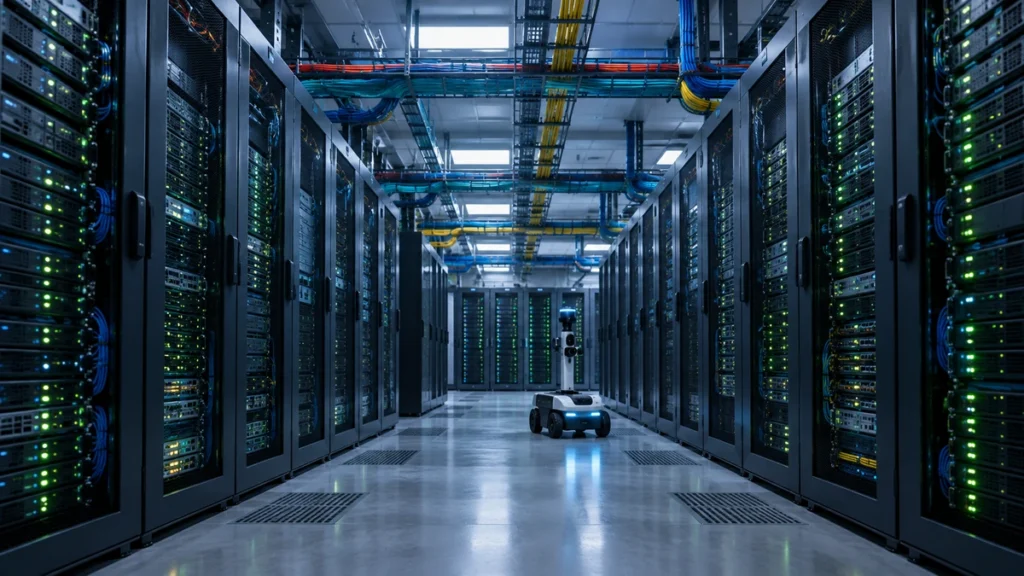
Physical AI enables machines, such as mobile robots, to understand their surroundings and act within them. In a data center, that could mean checking equipment temperatures, gathering evidence behind a cooling alert, inspecting hard-to-access areas or validating asset information.
Yet these capabilities rely on strong operational foundations. Facility design, information quality, governance and workforce readiness all play a role in determining whether physical AI can deliver lasting value.
Start with a clear operational purpose
The strongest business case for physical AI begins with a specific operational challenge rather than a desire to deploy new technology.
Physical AI can be particularly valuable where inspections are repetitive, access is difficult, investigation times are lengthy or conditions present increased risk to personnel. While Data Center Infrastructure Management (DCIM) and Building Management Systems (BMS) already provide extensive monitoring, alerts do not always explain the cause of an issue. Thermal, visual or acoustic evidence gathered directly at the equipment can help teams understand what is happening and respond more effectively.
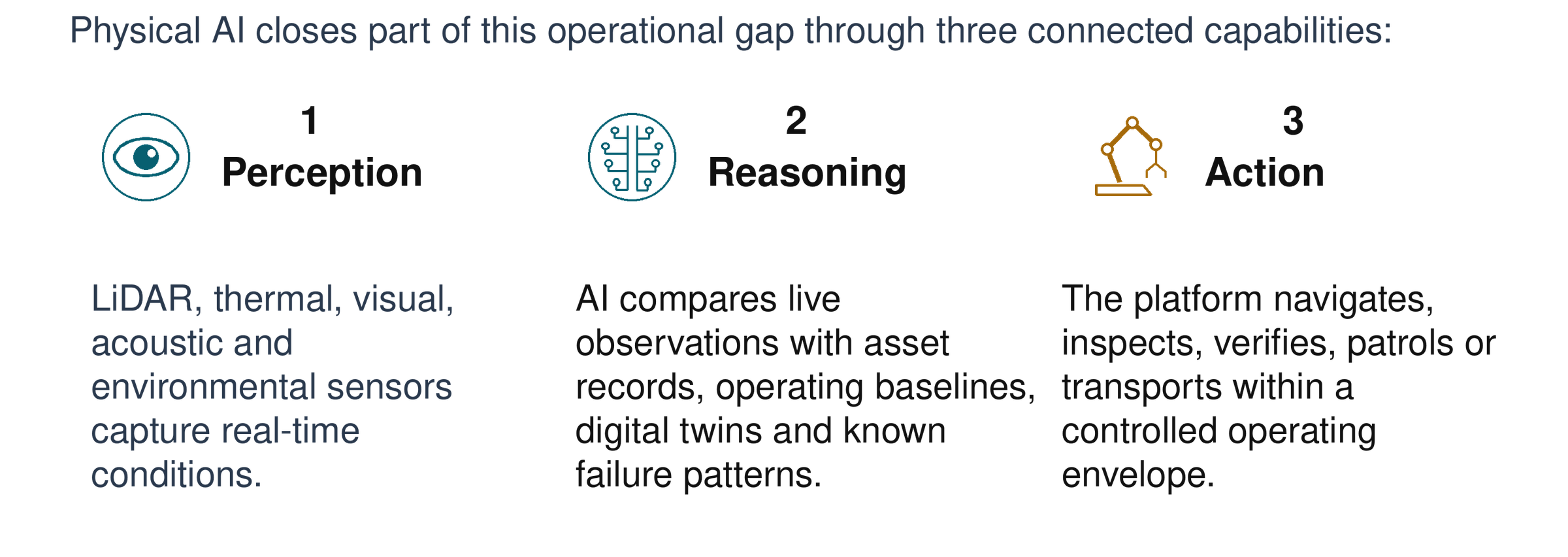
This process combines perception, reasoning and action. Sensors capture conditions, AI interprets the observations against known operating parameters and the platform carries out an authorized task. Critical decisions, however, remain with people.
Potential applications extend beyond inspections. Physical AI may assist with asset verification and inventory checks, transport tools or spare parts, support post-incident assessments and help investigate cooling anomalies or leaks.

The value comes not from automation alone, but from improving diagnosis, reducing exposure to risk and allowing skilled personnel to focus on higher-value activities.
Information readiness is essential
Physical AI is only as effective as the information available to it.
Outdated layouts, incomplete asset records or inaccurate facility data can significantly limit a platform’s ability to understand its environment. Machine-readable spatial models, such as navigable building information modeling (BIM) or digital twins, along with standardized asset IDs and up-to-date rack and plant records, provide the context for reliable observations and navigation.
Physical access must also be considered. Clearances, raised floors, restricted zones and emergency routes influence where machines can operate safely. Charging and docking locations need to be integrated into daily operations without creating conflicts with maintenance activities or personnel movement.
Connectivity presents another challenge. Safety-critical functions, including navigation, collision avoidance, emergency stopping and basic hazard response, must continue to operate locally on the platform if wireless, cloud or wide-area communications are interrupted.
Addressing these requirements early helps organizations avoid turning a promising pilot into a complex operational burden.
Governance and accountability cannot be an afterthought
As physical AI becomes more capable, clear governance becomes increasingly important.
An inspection platform that collects readings requires a very different level of authority from a system capable of interacting with operational equipment. Defined limits on autonomous actions, human oversight, traceable records and clear escalation processes help establish accountability. Operating rules should also specify geofenced routes, speed limits, exclusion zones, safe docking and battery-charging controls, fail-safe states and immediate human override.
Cybersecurity requirements are equally important. Network segmentation, verified device identities, encrypted communications, controlled access permissions and secure update processes all help protect interactions between physical AI platforms and critical facility systems.
Responsibility extends beyond deployment. Maintenance, incident response, safety management, privacy, change control , AI model validation, data retention and operational assurance all require clear ownership. Organizations must also define who can authorize physical actions and how machine observations and decisions are logged, reviewed and audited. Success depends on alignment between operations, facilities, cybersecurity, IT, health and safety and security teams.
People remain central to success
Readiness is not only a technical issue. Workforce acceptance and confidence play an important role in the success of any physical AI program. Teams need to understand how systems operate, where human oversight remains essential and how automation supports rather than replaces their expertise.
The most successful deployments typically position physical AI as a tool that enhances human capability, improves safety and reduces repetitive tasks, allowing personnel to focus on more complex operational responsibilities.
Building that trust early is often as important as deploying the technology itself.
Pilot, learn and scale
A structured adoption journey allows organizations to evaluate both benefits and risks before making larger investments.
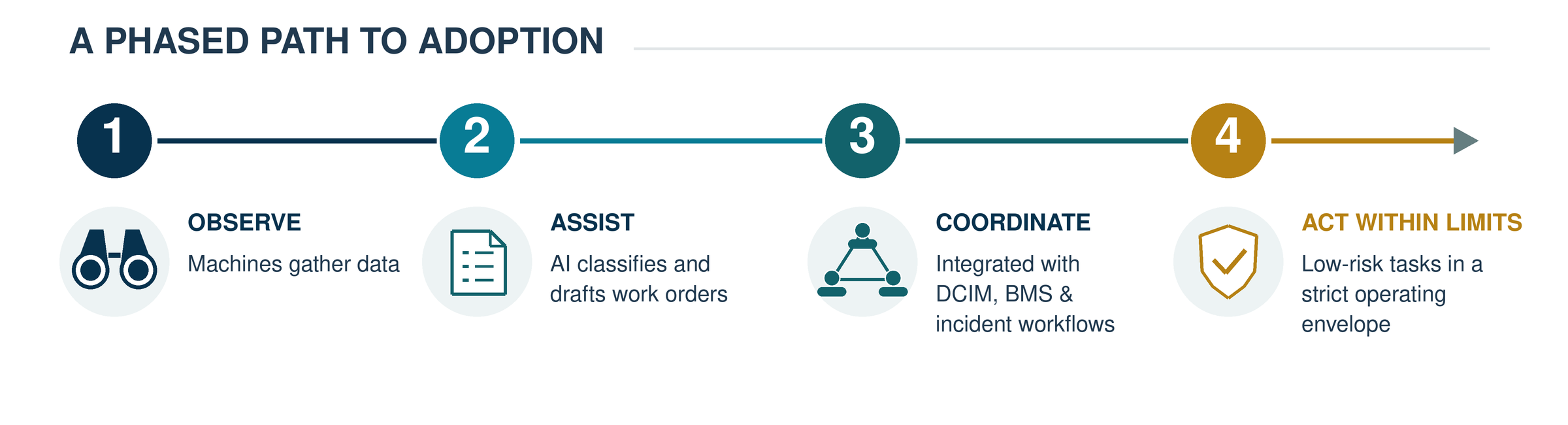
A focused pilot can establish measurable performance against existing processes and provide evidence of operational value. Organizations typically progress from observation and data collection to AI-assisted analysis, followed by integration with monitoring, maintenance and incident-response workflows.
Physical actions introduce additional requirements around authorization, supervision and continuous monitoring, making it important to expand capabilities in a controlled manner.
Faster inspections alone may not justify wider deployment if they require extensive intervention, generate additional maintenance demands or create new operational risks. Each pilot should be assessed against documented acceptance criteria covering safety, operational reliability, measurable value, workforce acceptance and controlled autonomy, alongside ongoing maintenance and support requirements.
Building the right foundations first
The organizations most likely to succeed with physical AI will not necessarily be those adopting it first. They will be those that establish the operational, information and governance foundations needed to use it safely, effectively and at scale.
Physical AI has the potential to transform how data centers inspect, monitor and manage their environments. But lasting value comes when the technology is introduced as part of a well-defined operating model, supported by reliable information, clear accountability and teams that are ready to use it.
Only then can physical AI move from an interesting capability to a sustainable operational advantage.