
The Hub: Preserving Art & Culture Through a Landmark Kuwaiti Platform
Khatib & Alami (K&A) was commissioned by the Municipality of Kuwait to undertake the design of the Hub of Arts, an ambitious project that is set to preserving Kuwait’s heritage and contributing to its socio-economic and cultural development.
The Hub’s primary purpose is to have a tangible and positive impact on human development by stimulating a passion for the arts, a quest for knowledge, and community involvement. As a result, our experts designed the project to accommodate a variety of recreational and cultural activities, positioning it as a communal and economic hub in Kuwait. The design also considered various sustainability features to achieve LEED Gold certification.
Building A Thriving Artistic Community
The Hub of Arts is a centralized cultural exchange space where people from all walks of life come together to share resources, learn new skills, meet community needs, and create art. It allows artists and supporting organizations to collaborate in a creative and lively environment.
Following a thorough urban study to determine the urban and built environment context, the project’s strategic positioning, accessibility, and linkages to neighboring areas, our design team has developed three alternatives with contrasting architectural approaches and program implementation.
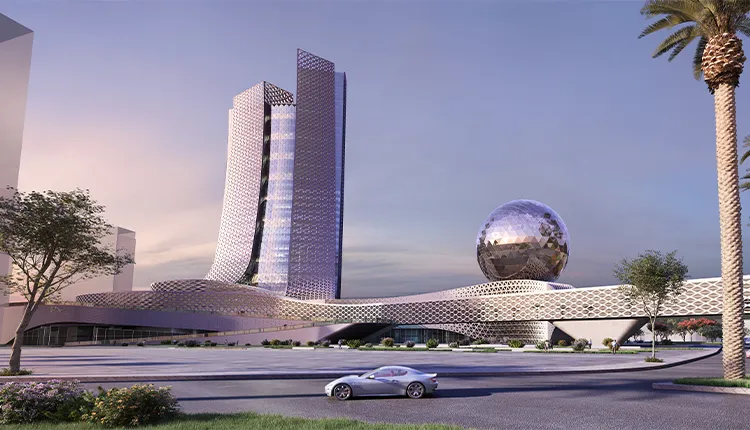
The result comprised an innovative, iconic architectural design that met LEED criteria, integrated various arts, education, and leisurerelated services in a connected community space with ease of internal movement.
The Spine Acts as The Project’s Backbone
Setting the base for the Hub’s design, K&A introduced several modern components to support innovation and learning objectives, enhancing its attractiveness and socioeconomic role. Fadi Hindi, K&A Buildings Director, said: “We designed the Hub of Arts in Kuwait with a double vocational strategy.
The first is to adapt and turn the project challenges into opportunities, while articulating its iconic architectural design.
The second is to link the different nodes of the complex with a comprehensive spine, bringing programmatic dynamism, interactive exchange spaces, and harmony between its components.”
One of the most difficult challenges was creating a cohesive project on a fragmented site. To address this issue, our designers proposed developing a spine that connects the three separate plots into one project, based on four main pillars:
- The Hub’s cultural role in the historic urban fabric, in relation to inclusive and sustainable development.
- Cost efficiency and sustainability as vital elements, when designing a building for the future.
- The role of program and project flexibility in extending the lifespan of cultural structures, as well as their capacity to accommodate various operational spaces and perform specific functions based on user needs.
- Ease of implementation, when addressing the construction and development of each part of the project.
An Architectural Identity Between Traditional and Contemporary
Inspired by Kuwait’s ancient history and marine environment, the Hub’s architectural design boasts a fluid, water-inspired organic, and dynamic structure. Its skyline, similar to a splashing wave, symbolizes the rise of modernity and evolution while the 3D sphere, which is considered as the principal attraction, keeps Kuwait’s traditional identity remarkably visible. Designed like a huge pearl, it symbolizes the country’s ancient economic pillar, balancing its bifold historical and natural origins.
The developed alternative consists of a hybrid installation that combines program functions and highlights the links to its immediate surroundings, stitching the city into the building’s private, semi-private, and public spaces.
Our designers envisioned the spine as the project’s lungs, which connects its disparate components and houses a series of public landscaped spaces on various levels, bringing life, nature, and communal space to the project’s interior.
Furthermore, a series of recesses and protrusions that reflect the dynamic in the combination of functions breaks the linearity of the silhouette. The wavy volumes, which are separated by three big cuts and linked by a bridge, resulting in the curvy façade of the hotel towers. The proportions of the further emphasize the project’s fluidity and dynamism. Triangular cladding covers the facades and extends to the shaded areas of the hotel. Two exterior rotators structures enter and rotate through the hotel’s atrium apertures. The green piazzas located at different levels with the central spine extending to the hotel tower.
Parametric Design in Sustainable Architecture
K&A designed the project to achieve LEED Gold sustainable goals.
The façade’s parametric design, boosted by computer algorithms, has played a major role in regulating sustainable architecture variables, such as sun rays and thermal comfort. Fadi Hindi explained: “We opted for a parametric skin to cover the project’s envelope, combining multi rendering applications, such as Revit, Rhinoceros, and GrassHopper. Using computational approaches, the triangular motifs assist in controlling the aperture in the curtain wall, whereas the parametric skin to improve beauty and adapt smartly to its fresh incoming air, maximizing the amount of natural light entering.”
At the same time, we design a hub that aims to develop a focus on Kuwait’s long standing engagement for innovation and development.
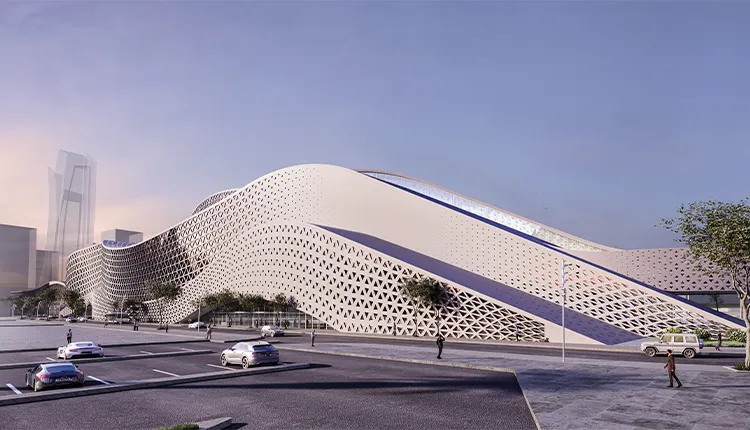
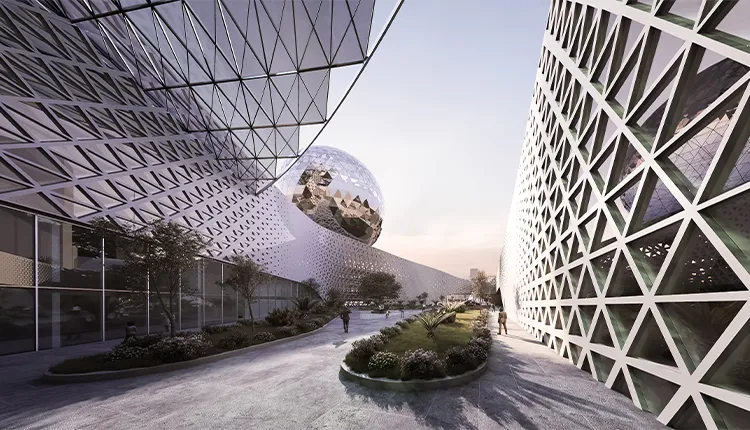
As a result, the design team proposed innovative programs with many distinct aspects and functions, such as a 3D technology sphere with panoramic screens on its outside envelope and a technology hall and bleachers on the interior for animated projection events, and other technology-related features.
“The inspirational and innovative ambitions of the Hub anchor the development of creativity, arts, leisure, and diversity, while implementing a positive, competitive, and sustainable imprint on communities.”