

What shapes an engineer’s career?
In conversation with Hasan Shahine, Senior Project Mechanical Engineer at Khatib & Alami
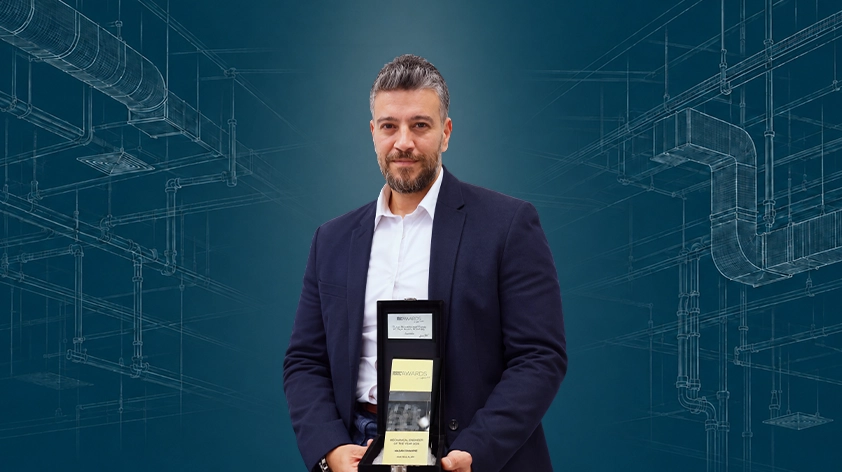
Following his recognition as Mechanical Engineer of the Year at the MEP Middle East Awards 2026, Hasan Shahine reflects on the learning, projects and relationships that shape a career in engineering.
What do you wish you had known when you started your engineering career?
That growth takes time. You graduate expecting exciting projects, responsibility and big decisions, but responsibility is not a right – it’s something that you earn by proving yourself.
Patience matters, but so does owning your development. Your university, company and manager can support you. You still need to ask questions, seek experience and take on unfamiliar challenges.
What does taking on an unfamiliar challenge look like in your work?
Two healthcare projects at K&A come to mind.
At The View Hospital in Doha, we were converting a residential tower into a hospital while construction was underway. We had to rethink plant areas and service routes, add shafts and fit healthcare systems into a building never designed for them – all while coordinating with the wider team to minimize disruption.
Barbir Medical Center in Beirut had been closed for around 30 years. Its poor condition and restricted service routes made the renovation and expansion particularly demanding. We had to accommodate modern healthcare systems and adapt as hidden conditions emerged during construction.
Both required technical knowledge and the judgment to question assumptions, change a solution or involve another discipline.
What did that coordination teach you about the people side of engineering?
How you communicate matters as much as the information you share. A change to a service route can affect several disciplines. Resolving it means understanding their requirements and explaining your own clearly.
Trust, negotiation and openness to different perspectives are part of the work every day. Technical skills get you started; people skills help you make an impact.
If you were starting again, what would you explore earlier?
More hands-on experience in manufacturing, product development and site work, alongside learning about management, finance, coding, contracts and negotiation.
Digital tools and automation now support how we evaluate and coordinate designs. Using them effectively requires understanding their assumptions and limitations, too.
Mechanical engineering can be your foundation, but it doesn’t have to be your boundary.
How do you help younger engineers develop their judgment?
Through technical discussions, shared reviews and practical training. The aim is to help them understand why a decision is appropriate and how a system should perform in operation.
Reviewing work together connects calculations with practical requirements. It gives engineers and trainees space to ask questions, examine assumptions and learn from others—carrying experience from one project into the next.
What has being part of K&A meant to you?
The professional family I have found at K&A has helped shape who I am today. The relationships matter alongside the experience.
What keeps you interested in engineering today?
Turning ideas into something real—and knowing there is always more to learn.
What matters most is how well the engineering serves the facility and its users. Our decisions have consequences long after construction ends. Keeping those in view is part of our responsibility.
If I had to choose engineering again, I would.
Explore Careers at K&A: Discover our teams and current opportunities.